The Compatibility Score Is Not a Verdict
A compatibility score can start a useful conversation, but a week of reflection helps separate a suggestive result from a fuller view of two people.
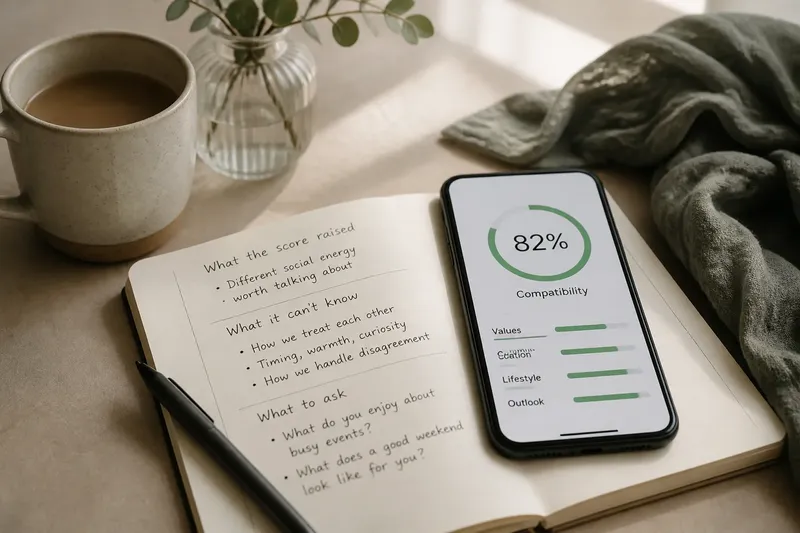
A compatibility score can look unusually decisive on a quiet evening: two people answer the same questions, a number appears, and the screen seems to have settled what a meeting might take several conversations to reveal. Treat that score as a prompt, not a verdict. It can help name a point of agreement or a difference to consider; it cannot contain the whole character of either person.
A sensible way to use a result is to give it a week of attention, then put it back in proportion. The aim is not to turn dating into a small research project. It is to notice what the score makes you curious about, check whether its claims fit ordinary experience, and leave room for the parts it cannot assess.
On the first day, check what the score actually describes
Before deciding what a number means, look at the language around it. Does the service call it compatibility, shared preferences, or a match rating? Those labels sound similar, but they may describe different things. A result based on stated preferences says something about answers supplied at a particular moment, not about how two people treat each other.
Also notice whether the result is accompanied by categories or explanations. A broad score without a clear account of its inputs deserves less authority than one that shows which answers contributed. Even then, the categories are a map of the questions asked, not a portrait of everything that matters.
Ask yourself what decision the number is being asked to make. If it is being used to decide whether to accept an introduction, it may be one consideration among several. If it is being used to declare that a person is unsuitable before any conversation, it is carrying more weight than the information can support.
On the second day, separate preference from principle
People often answer questions about habits, tastes and hopes as though they all carry the same importance. They do not. A preference for quiet weekends may be flexible; a firm wish about children, religion, or where to live may shape the life someone is willing to build. A score may count both as differences without conveying their different consequences.
Make a private note of which answers concern everyday style and which concern a boundary or long-term direction. Keep the note brief. The purpose is not to rank a stranger against an imagined ideal, but to see whether a result has blurred a negotiable difference with a substantial one.
There is little value in dissecting every item or trying to reverse-engineer the service’s formula. That effort can create an air of precision without giving you better grounds for a decision. Focus instead on the claims that would alter your willingness to meet or continue.
On the third day, read a difference in context
A mismatch can be informative without being disqualifying. Two people may prefer different ways to spend an evening and still enjoy each other’s company; two people may report similar ambitions yet disagree about what those ambitions require in daily life. The score records an answer. Context tells you what the answer means to each person.
Imagine you receive an introduction and the score flags different social preferences. You prefer small gatherings; the other person says they enjoy busy events. Rather than treating that contrast as a forecast, you could ask what each of you likes about those settings. The observable result is not a prediction of success, but a clearer account of whether the difference feels easy, negotiable or tiring to either of you.
This is also why a high score needs modest handling. Similar answers can conceal different motives. One person might value a settled routine for comfort, another for convenience; the match between their selections does not establish a match in how they understand those choices.
On the fourth day, notice what the score leaves out
A questionnaire cannot observe timing, warmth, tact, curiosity, or the small decisions that make an exchange comfortable. Nor can it know whether someone feels free to disagree, or whether a conversation leaves both people with a clearer sense of themselves. These things emerge through interaction, not by being inferred from a tidy display.
That does not make scores useless. A result can supply a subject worth discussing, especially when it reveals an assumption you had not noticed. But it should not replace direct impressions, and direct impressions should not be mistaken for certainty either. One encounter gives you information about that encounter.
Consider whether the result has made you more open to a useful question or more eager to defend a number. The first response can help a meeting begin. The second can turn two people into representatives of their answers before either has had a chance to speak plainly.
During the week, what should you ask yourself?
What does a high compatibility score tell me?
It tells you that the answers and categories used by that service produced a favourable result under its own method. It does not establish how either person will communicate, handle disagreement, or feel in one another’s company.
Should a low score stop an introduction?
Not by itself, unless the result points to a difference that matters to your own settled priorities. Check what sits behind the rating, then decide whether the issue merits a conversation or is a genuine reason to decline.
Can similar answers still lead to a poor fit?
Yes. People can choose the same response for different reasons, and a questionnaire may not ask about the everyday circumstances that shape those choices.
When should I give the score no further attention?
When you understand what it measures and it has no bearing on a real question you need to resolve. At that point, more interpretation is unlikely to add much; pay attention to the actual exchange instead.
At the end of the week, give the result its proper weight
Return to the score once, with your notes beside it. Name what it usefully raised, what it cannot establish, and whether any difference calls for a direct conversation. If it has not changed a real question, it need not dictate a decision.
The compatibility score is not a verdict; it is a small piece of information with a particular scope. Use it to make your attention more precise, not to make your judgement less human. A number can point to a subject worth discussing, but the quality of that discussion belongs to the people having it.